



What Is AI in Performance Marketing?
- •Performance marketing focuses on measurable outcomes like clicks, conversions, and revenue.
- •AI processes massive datasets in real-time to optimize campaigns that manual methods can't match.
- •Businesses of all sizes now use AI to predict behavior and adjust campaigns automatically.
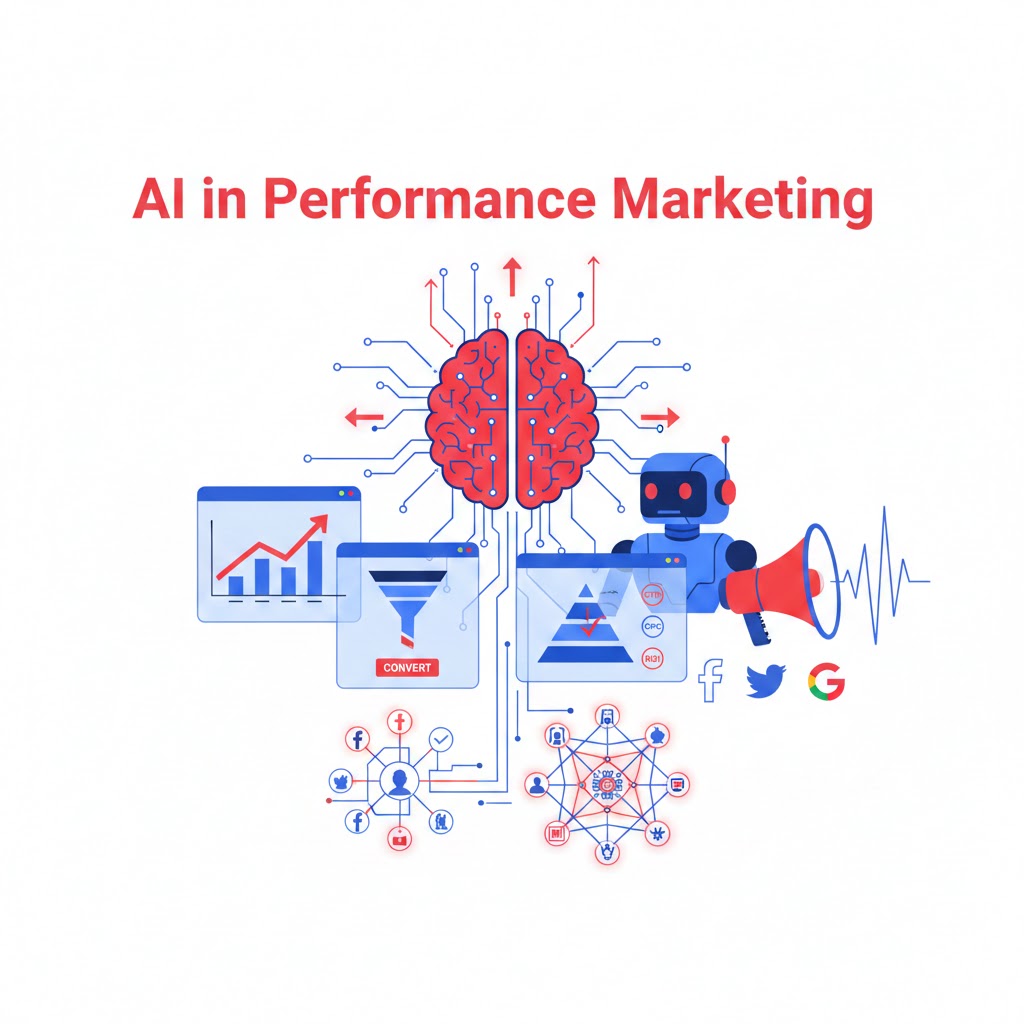
In 2026, AI is transforming performance marketing by enabling marketers to optimize campaigns, track ROI accurately, and deliver personalized experiences at scale. Businesses of all sizes are adopting AI tools to analyze customer data, predict behavior, and automatically adjust campaigns for maximum effectiveness.
Performance marketing has always been about measurable results. Marketers track impressions, clicks, conversions, and revenue to determine the effectiveness of campaigns. AI enhances this by processing massive datasets in real-time and making predictions that guide strategy.
Core AI Capabilities in Marketing
- •Automated bid management adjusts ad spend in real-time for better ROI.
- •Predictive lead scoring prioritizes high-potential prospects.
- •Dynamic creative optimization serves the best ad variant automatically.
Automated Bid Management
AI adjusts bids for ads in real-time based on performance data and market trends — without any human input. This means your budget is always allocated where it delivers the most value.
Predictive Lead Scoring
AI predicts which leads are most likely to convert, allowing marketers to focus energy on high-potential prospects and reduce wasted sales effort.
Dynamic Creative Optimization (DCO)
AI tests multiple ad creatives simultaneously and automatically serves the best-performing version to each user segment.
| Capability | Traditional | AI-Powered |
|---|---|---|
| Bid Adjustment | Manual, slow | Real-time, automatic |
| Audience Segmentation | Broad demographics | Behavioral micro-segments |
| A/B Testing | Sequential, weeks | Parallel, hours |
| Attribution | Last-click only | Multi-touch, AI-modeled |
| Personalization | Rule-based | Predictive, dynamic |
Audience Segmentation & Personalization
- •AI groups customers by behavior and intent, not just demographics.
- •Micro-segmentation unlocks niche audiences that generic targeting misses.
- •Churn prediction lets you run retention campaigns before customers leave.
AI-powered segmentation allows marketers to group customers based on behavior, purchase history, and real-time intent signals. This goes far beyond traditional age/gender targeting.
- Personalized emails, landing pages, and ads lead to higher engagement and conversion rates.
- Machine learning models detect micro-segments, helping brands deliver highly relevant content to niche audiences.
- AI can predict when a customer is likely to churn and trigger retention campaigns proactively.
- Real-time behavioral data enables 1-to-1 personalization at scale.

How AI narrows broad audiences into high-intent micro-segments
A funnel diagram showing: Raw Audience → Behavioral Filters → Intent Signals → Micro-Segments → Personalized Campaigns. Each stage reduces audience size while increasing conversion probability.
Optimizing Campaign Performance
- •AI continuously monitors KPIs and reallocates budget to top-performing channels.
- •Automated A/B testing at scale removes guesswork from creative decisions.
- •Low-performing ads are paused automatically, reducing wasted spend.
AI continuously monitors KPIs and suggests — or automatically implements — actionable improvements across your campaigns.
- Adjust budget allocation to channels with the highest ROI.
- Pause low-performing ads and reallocate resources to winning campaigns.
- Run A/B tests at scale and automatically implement the most effective variations.
- Detect anomalies and alert marketers to sudden performance drops.
Predictive Analytics in Marketing
- •AI forecasts campaign performance before you spend a dollar.
- •Predictive models identify your best customers before they even convert.
- •Timing optimization ensures your messages land when users are most receptive.
AI predicts future trends based on historical data, allowing marketers to anticipate customer needs instead of reacting to them.
- Forecast campaign performance and revenue outcomes before launch.
- Identify high-potential customers before they convert.
- Optimize timing for marketing messages to maximize engagement.
- Reduce waste by predicting which segments won't convert.
Real-World AI Performance Marketing Tools
- •Several mature AI tools cover ads, email, CRM, and attribution.
- •Each tool specializes in a different part of the marketing funnel.
- •Combining tools requires careful integration planning.
| Tool | Best For | Key AI Feature | Pricing Tier |
|---|---|---|---|
| Google Ads Smart Bidding | Paid search & display | Real-time bid optimization | Pay-per-use |
| HubSpot AI | Email & CRM | Lead scoring + workflow automation | Starter–Enterprise |
| AdRoll AI | Retargeting | Cross-channel audience optimization | Self-serve |
| Salesforce Einstein | Enterprise sales | Predictive lead scoring + insights | Enterprise |
| Klaviyo AI | E-commerce email | Predictive send-time + churn scoring | Usage-based |
Measuring ROI with AI
- •AI multi-touch attribution replaces last-click guesswork.
- •Real-time dashboards cut manual reporting time dramatically.
- •Predictive ROI models let you forecast before you launch.
AI enables accurate attribution of marketing spend to revenue — one of the hardest problems in marketing.
- Multi-touch attribution models identify which channels contribute most to conversions.
- Real-time AI dashboards reduce manual analysis time by up to 80%.
- Predictive ROI models forecast revenue outcomes for new campaigns before launch.
Case Study: AI-Powered Retargeting
- •A real e-commerce brand used AI retargeting to recover abandoned carts.
- •Dynamic creative optimization served personalized ads based on browsing history.
- •Results: 43% lower CPA and 2.8× ROAS improvement in 60 days.
NovaMart (E-commerce)
Retail / E-commerceNovaMart was spending 40% of its ad budget on retargeting with a high cost-per-acquisition (CPA) and poor return on ad spend (ROAS). Manual bid management couldn't keep up with the volume of SKUs and customer segments.
Integrated AdRoll AI with their Shopify store and CRM. Enabled dynamic creative optimization to serve product-specific ads based on each user's browsing history. Activated AI-driven bid management across Google, Meta, and display networks.
Within 60 days, NovaMart reduced CPA by 43% and improved ROAS from 1.8× to 5.0×. Cart abandonment recovery emails, timed by AI, contributed an additional 18% revenue uplift.
Challenges in AI Performance Marketing
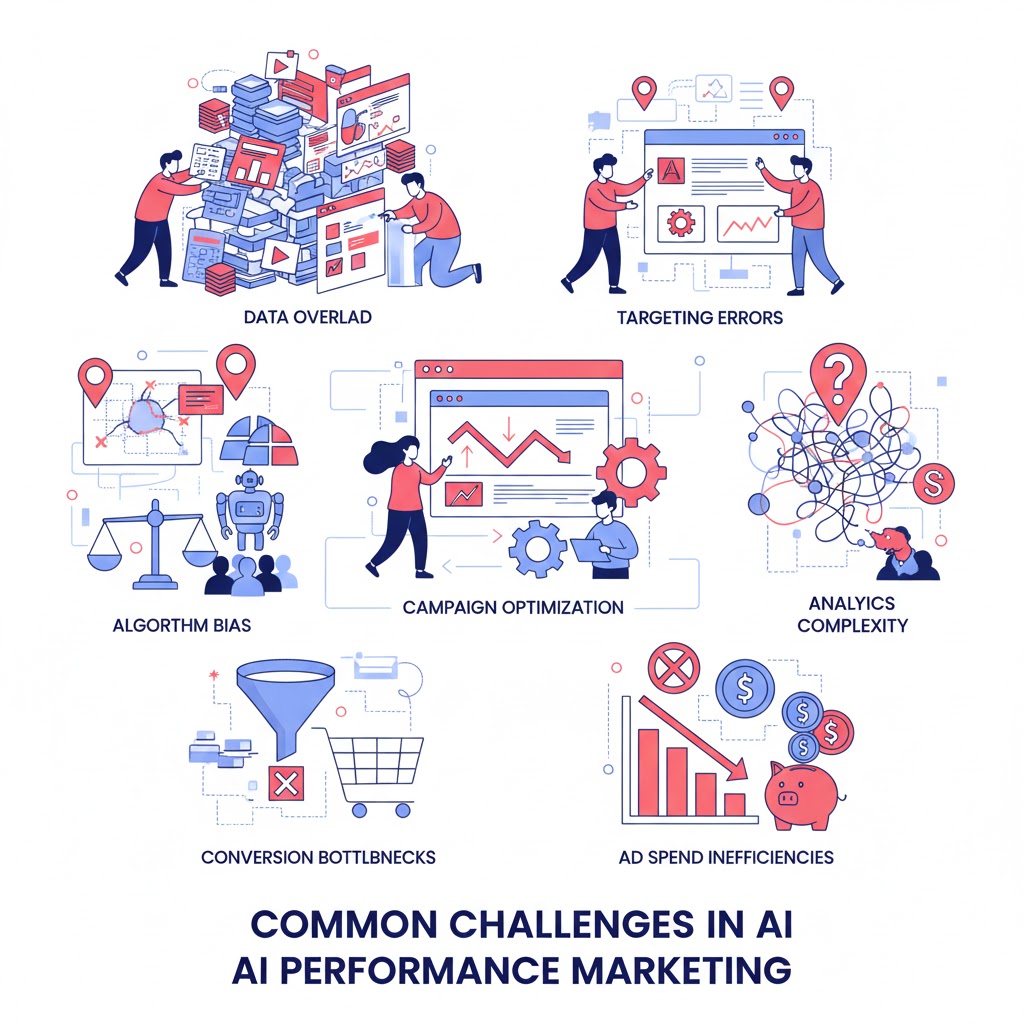
- •AI is only as good as the data feeding it — quality matters.
- •Privacy regulations like GDPR and CCPA add compliance complexity.
- •Human oversight is still required; AI provides recommendations, not verdicts.
| Challenge | Impact | Mitigation |
|---|---|---|
| Data quality | Models produce bad predictions | Audit & clean data before AI adoption |
| Privacy compliance | Legal risk, fines | Implement consent management platforms |
| Human oversight gap | Poor decisions go unchecked | Set review checkpoints for AI actions |
| Integration complexity | Fragmented data & workflows | Use a central CDP or marketing OS |
| Algorithm bias | Skewed targeting | Regular fairness audits on model outputs |
Step-by-Step AI Implementation for Marketers
- •Implementation should start with an honest audit of current campaign data.
- •Pilot before scaling — test AI on a small budget before full rollout.
- •Use the checklist below to track your progress.
- Audit existing campaigns — Analyze performance metrics, channel effectiveness, and data quality.
- Select AI tools — Choose platforms that match your goals (ads, email, analytics, personalization).
- Integrate with your marketing stack — Connect AI tools to CRM, email, social, and ad platforms.
- Train your team — Ensure marketers understand AI insights, dashboards, and recommended actions.
- Launch pilot campaigns — Test AI recommendations on a small scale before rolling out broadly.
- Measure, learn, iterate — Continuously monitor AI performance, adjust strategies, and expand successful campaigns.
✓ AI Marketing Implementation Checklist
- Data audit complete
All campaign data is clean, deduplicated, and accessible.
- AI tools selected and procured
Platforms chosen for ads, email, analytics, and personalization.
- CRM and ad platform integrations live
AI tools are pulling and pushing data from all key systems.
- Team training complete
Marketers can read AI dashboards and interpret recommendations.
- Pilot campaign launched
At least one channel is running under AI optimization.
- Attribution model configured
Multi-touch attribution is active and validated.
- Privacy compliance reviewed
All AI campaigns comply with GDPR, CCPA, and local regulations.
- Review cadence established
Weekly or bi-weekly human review of AI decisions is scheduled.
Future of AI in Performance Marketing
- •AI-generated creative will become standard across all major ad platforms.
- •Multi-channel orchestration will unify search, social, email, and AR/VR.
- •Ethical AI and transparency will become competitive differentiators.
- Greater automation across all channels — including voice and connected TV.
- AI-driven creative generation and dynamic ad content tailored to each user.
- Deeper personalization using unified multi-channel customer data profiles.
- Predictive marketing strategies based on real-time consumer trends.
- Integration with AR/VR experiences for immersive, shoppable campaigns.
- Ethical AI frameworks ensuring fairness, transparency, and consumer trust.