



What Is Fullstack Web3 Development?
- •Web3 is the decentralized evolution of the internet — built on blockchains instead of central servers.
- •Fullstack Web3 covers the smart contract layer (backend), the frontend UI, and decentralized storage.
- •Web3 developers are among the highest-paid in tech, with demand outpacing supply significantly.
Web3 represents the next generation of the internet — one where applications run on decentralized networks, users own their data, and code executes trustlessly via smart contracts. Unlike Web2, where your data lives on company servers, Web3 applications (dApps) store logic on the blockchain and data on decentralized networks like IPFS.
Fullstack Web3 development means building every layer of a decentralized application: the smart contracts that power the backend logic, the frontend that users interact with, the wallet connections that authenticate users, and the decentralized storage that keeps data permanent and censorship-resistant.
The Fullstack Web3 Stack Explained
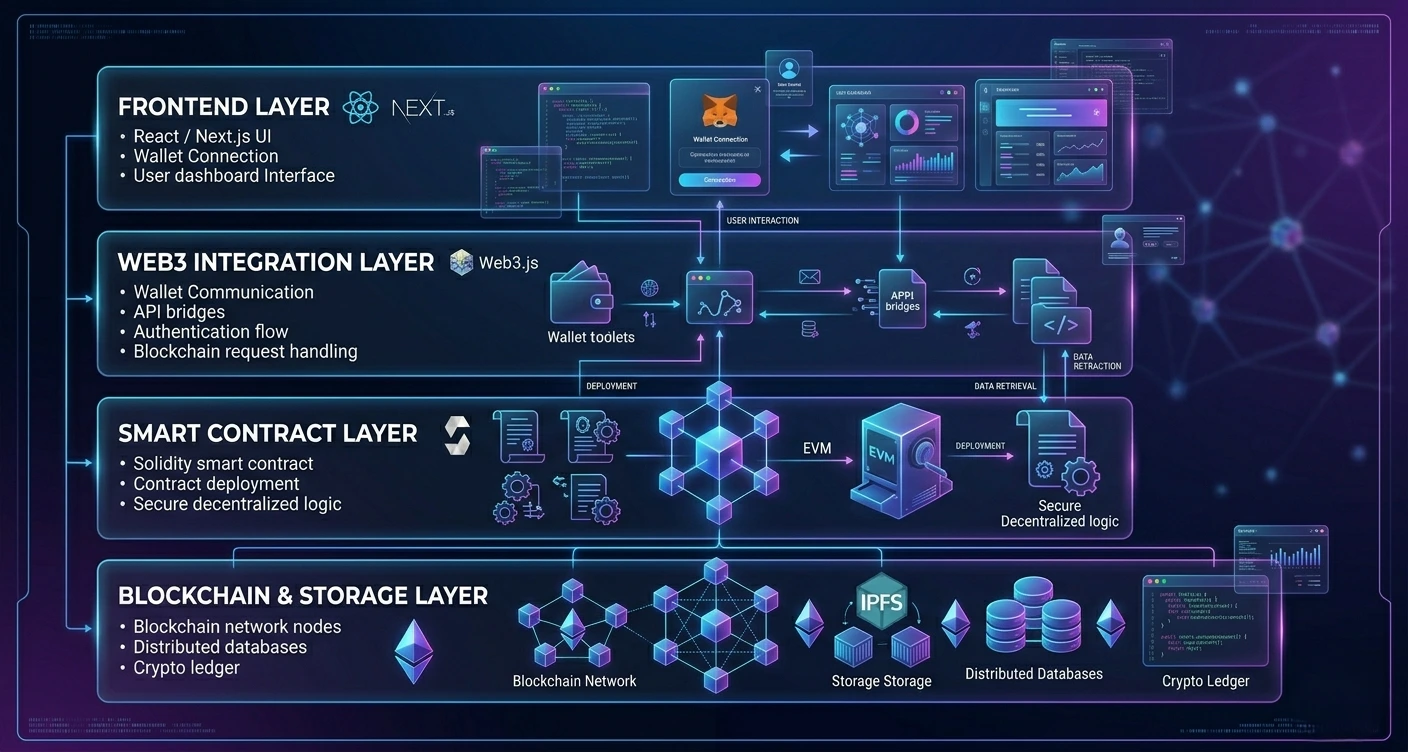
- •The Web3 stack has four layers: blockchain, smart contracts, frontend, and storage.
- •Each layer has its own tools and languages — most are familiar to Web2 developers.
- •Ethereum and EVM-compatible chains remain the dominant development environment in 2026.
A fullstack Web3 application is made up of four distinct layers. Understanding what each layer does and which tools power it is the foundation of becoming a Web3 developer.
| Layer | Role | Key Tools & Languages |
|---|---|---|
| Blockchain | Decentralized execution environment | Ethereum, Polygon, Solana, Base, Arbitrum |
| Smart Contracts | Backend logic — trustless, on-chain code | Solidity, Vyper, Rust (Solana), Foundry, Hardhat |
| Frontend | User interface that talks to the blockchain | React, Next.js, ethers.js, wagmi, RainbowKit |
| Storage | Decentralized file and data storage | IPFS, Filecoin, Arweave, The Graph (indexing) |
| Wallet / Auth | User identity and transaction signing | MetaMask, WalletConnect, Privy, Dynamic |
Choosing Your Blockchain
- •Ethereum is the most battle-tested smart contract platform but has the highest gas fees.
- •Layer 2s like Base, Arbitrum, and Polygon offer Ethereum security at a fraction of the cost.
- •Solana is a strong choice for high-throughput apps that need fast, cheap transactions.
The blockchain is the foundation your dApp runs on. Your choice of chain affects transaction speed, cost, developer ecosystem, and user base. In 2026, most new projects deploy on Ethereum Layer 2 networks for the best balance of security and cost.
| Chain | Type | Avg Gas Fee | TPS | Best For |
|---|---|---|---|---|
| Ethereum | L1 | $1–$15 | ~15 | High-value DeFi, NFTs, established protocols |
| Base | L2 (Optimistic) | $0.001–$0.05 | ~2,000 | Consumer apps, social dApps, low-cost transactions |
| Arbitrum | L2 (Optimistic) | $0.001–$0.10 | ~4,000 | DeFi, gaming, EVM-compatible projects |
| Polygon | L2 / Sidechain | $0.001–$0.01 | ~7,000 | Enterprise, gaming, mass-market dApps |
| Solana | L1 | <$0.001 | ~65,000 | High-frequency apps, payments, NFT marketplaces |
For most beginners, Base or Arbitrum is the recommended starting point in 2026. Both are EVM-compatible (meaning your Solidity code works as-is), have low fees, and have rapidly growing developer ecosystems.
Smart Contracts: The Web3 Backend
- •Smart contracts are self-executing programs stored on the blockchain.
- •Solidity is the dominant language for EVM-compatible chains.
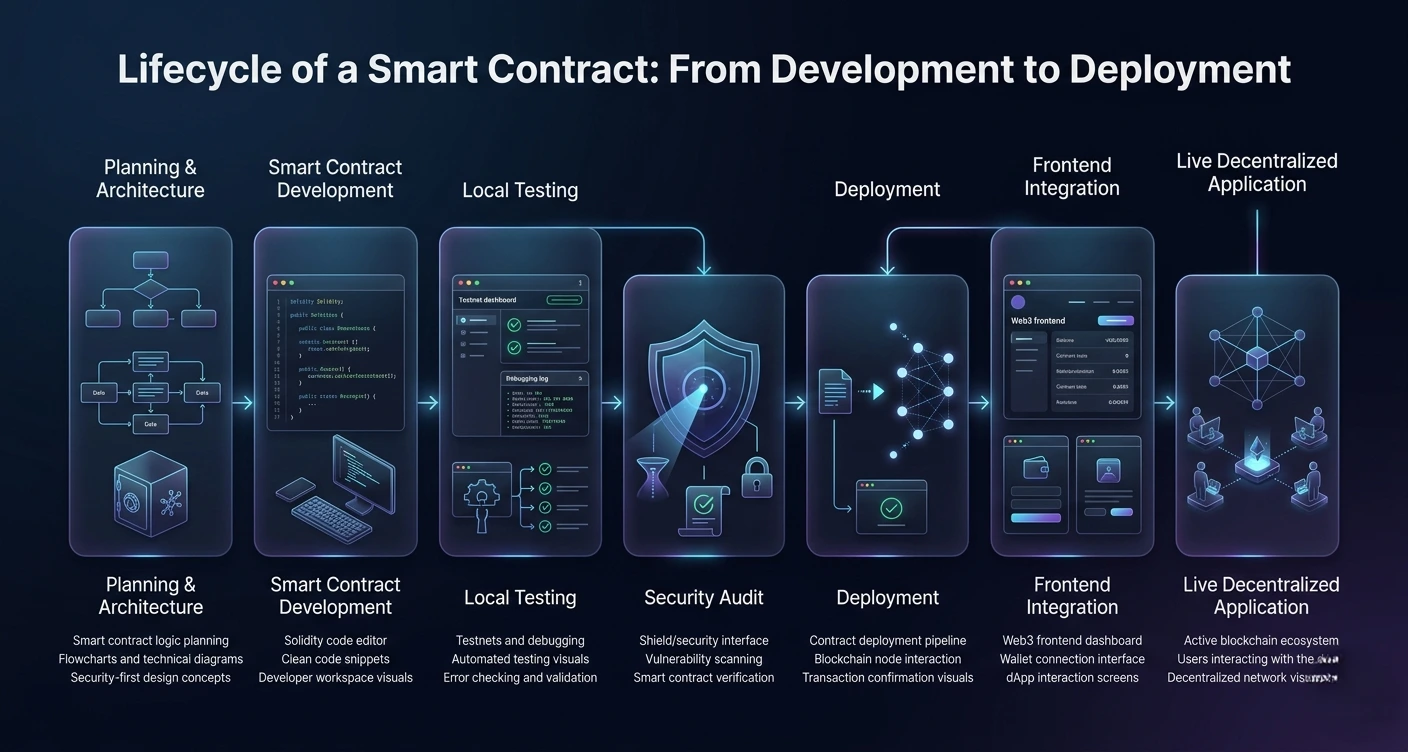
- •Foundry is the modern standard for testing and deploying smart contracts in 2026.
Smart contracts are the backend of Web3. They are programs that live on the blockchain and execute automatically when conditions are met — no server, no database, no intermediary. Once deployed, they are immutable and transparent.
Solidity: The Language of Smart Contracts
Solidity is a statically typed, contract-oriented language specifically designed for writing smart contracts on Ethereum and EVM-compatible chains. If you know JavaScript or TypeScript, the syntax will feel partially familiar — but the mental model is very different, since every function call costs real money (gas).
Smart Contract Development Tools
| Tool | Type | Best For | Language |
|---|---|---|---|
| Foundry | Testing & deployment framework | Modern Solidity development, fast testing | Solidity + Rust CLI |
| Hardhat | Testing & deployment framework | JavaScript-native teams, plugin ecosystem | Solidity + JavaScript |
| Remix IDE | Browser-based IDE | Beginners, quick prototyping | Solidity |
| OpenZeppelin | Smart contract library | Secure, audited base contracts (ERC-20, ERC-721) | Solidity |
| Slither | Static analysis tool | Security auditing and vulnerability detection | Solidity |
Key Smart Contract Standards to Know
- ERC-20 — The standard for fungible tokens (like USDC, DAI, and most DeFi tokens).
- ERC-721 — The standard for non-fungible tokens (NFTs); each token is unique.
- ERC-1155 — A multi-token standard supporting both fungible and non-fungible tokens in one contract.
- ERC-4337 — Account abstraction; enables smart contract wallets with features like gasless transactions and social recovery.
Building the Web3 Frontend
- •Web3 frontends are built with the same frameworks as Web2 — React and Next.js dominate.
- •ethers.js and wagmi are the primary libraries for connecting frontends to the blockchain.
- •Wallet connection UX is critical — libraries like RainbowKit make it simple.
Good news for Web2 developers: the Web3 frontend is still React. The key difference is that instead of calling a REST API, your frontend talks directly to the blockchain using a Web3 library. In 2026, wagmi v2 and ethers.js v6 are the industry standards.
Core Frontend Libraries
| Library | Role | Why Use It |
|---|---|---|
| wagmi v2 | React hooks for blockchain | Type-safe, composable hooks for reading/writing contracts |
| ethers.js v6 | Ethereum interaction library | Low-level blockchain calls, ABI encoding, wallet utilities |
| viem | TypeScript Ethereum interface | Lightweight, type-safe alternative to ethers.js; used under wagmi |
| RainbowKit | Wallet connection UI | Pre-built, beautiful wallet connect modal supporting 100+ wallets |
| Privy | Auth + wallet management | Handles both Web3 wallets and email/social login in one SDK |
| TanStack Query | Async state management | Pairs with wagmi for caching and syncing on-chain data |
How Wallet Connection Works
In Web3, there are no usernames or passwords. A user's wallet (like MetaMask or Coinbase Wallet) is their identity. When a user connects their wallet to your dApp, they prove ownership of their Ethereum address by signing a message — no personal data required. Libraries like RainbowKit and WalletConnect handle the entire connection flow out of the box.
- User clicks Connect Wallet on your frontend.
- A modal appears showing supported wallet options (MetaMask, Coinbase Wallet, WalletConnect, etc.).
- User selects their wallet and approves the connection.
- Your app receives the user's public wallet address — this is their identity.
- For actions requiring authentication, user signs a SIWE (Sign-In with Ethereum) message.
- Your app verifies the signature and grants access — no password ever stored.
Decentralized Storage: Beyond the Database
- •Storing data on-chain is expensive — decentralized storage keeps costs low.
- •IPFS is the most widely used decentralized storage protocol for dApps.
- •The Graph indexes blockchain data so your frontend can query it like a database.
Blockchain storage is expensive — storing 1MB on Ethereum can cost hundreds of dollars in gas. Instead, Web3 applications store large files and data off-chain on decentralized storage networks, and only store the content hash (a unique fingerprint) on-chain.
| Protocol | Type | Best For | Persistence |
|---|---|---|---|
| IPFS | Content-addressed storage | NFT metadata, images, documents | Requires pinning service (e.g. Pinata, Filebase) |
| Filecoin | Incentivized storage market | Long-term, guaranteed storage deals | Paid, permanent |
| Arweave | Permanent storage chain | Permanent data — pay once, store forever | Permanent |
| The Graph | Blockchain data indexing | Querying on-chain events and data via GraphQL | Real-time indexed |
The Graph deserves special mention — it solves one of the hardest problems in Web3: querying blockchain data efficiently. Instead of scanning every block for events, you write a subgraph (a set of indexing rules) and query it via GraphQL, just like a traditional API.
dApp Architecture: How It All Fits Together
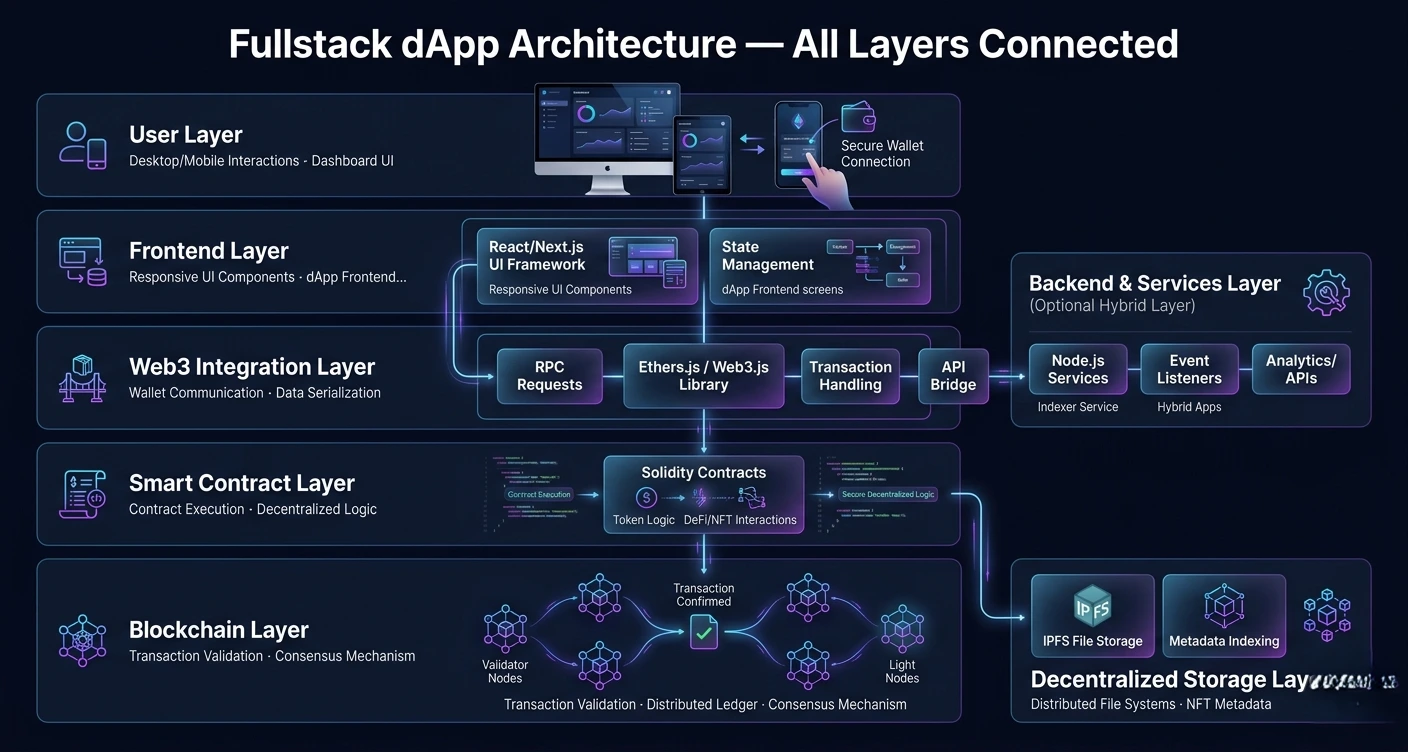
- •A dApp replaces the traditional backend server with smart contracts and decentralized infrastructure.
- •RPC providers like Alchemy and Infura connect your frontend to the blockchain node.
- •Most production dApps are hybrid: on-chain logic + off-chain data for the best UX.
Understanding how all the pieces connect is essential before writing a single line of code. A typical fullstack dApp in 2026 looks like this: a Next.js frontend connects to the blockchain via an RPC provider (like Alchemy or Infura), reads and writes data through smart contracts, authenticates users via their wallet, stores files on IPFS, and queries historical data via The Graph.
RPC Providers: Your Gateway to the Blockchain
- Alchemy — The most popular choice; offers enhanced APIs, WebSockets, and a generous free tier.
- Infura — Reliable, widely used, good for multi-chain projects.
- QuickNode — High performance, strong for latency-sensitive apps.
- Ankr — Affordable, decentralized RPC endpoints across 30+ chains.
- Public RPCs — Free but unreliable; never use in production.
Case Study: Building a Fullstack NFT Marketplace
- •A solo developer built a fullstack NFT marketplace on Base in under 4 weeks.
- •Stack: Solidity + Foundry + Next.js + wagmi + IPFS (Pinata) + The Graph.
- •The dApp processed over 1,200 transactions in its first month with zero server costs.
PixelVault (NFT Marketplace)
Web3 / NFTA solo developer wanted to build a fully decentralized NFT marketplace where artists could mint, list, and sell NFTs without paying platform fees to a centralized service. The challenge was building a complete fullstack dApp with no prior Web3 experience — only a strong React and Node.js background.
Built the marketplace on Base (Ethereum L2) using Solidity smart contracts (ERC-721 + marketplace logic) developed and tested with Foundry. The frontend was built with Next.js, wagmi v2, and RainbowKit for wallet connection. NFT metadata and images were stored on IPFS via Pinata. Historical sales data was indexed with a custom subgraph on The Graph for fast querying.
The marketplace launched in 28 days. In its first month, it processed 1,200+ transactions with an average gas fee of $0.003 per transaction on Base. Server infrastructure cost: $0 — the dApp ran entirely on decentralized infrastructure. The developer earned 2.5% in marketplace fees from $48,000 in total trading volume.
Web3 Security: What Every Developer Must Know
- •Smart contract bugs are permanent — unlike a web app, you cannot patch a deployed contract.
- •Reentrancy attacks and integer overflows are the most common exploit vectors.
- •Auditing and formal verification are essential before deploying any contract holding real value.
Security in Web3 is non-negotiable. Unlike a Web2 application where a bug can be patched in minutes, a deployed smart contract is immutable. If there's a vulnerability, attackers can drain funds before you can react — and billions of dollars have been lost this way. Web3 security must be built in from the start.
| Vulnerability | Risk | How to Prevent |
|---|---|---|
| Reentrancy Attack | Attacker drains contract funds by recursive calls | Use the Checks-Effects-Interactions pattern; use ReentrancyGuard from OpenZeppelin |
| Integer Overflow / Underflow | Math errors lead to unintended behavior | Use Solidity 0.8+ (built-in overflow checks) or SafeMath |
| Unchecked External Calls | Failed calls ignored, state corrupted | Always check return values; use call() with require() |
| Access Control Issues | Unauthorized users call privileged functions | Use OpenZeppelin's Ownable or AccessControl; test all roles |
| Front-Running | Bots exploit mempool to execute before user transactions | Use commit-reveal schemes or private mempools (Flashbots Protect) |
| Oracle Manipulation | Price feeds manipulated to exploit DeFi logic | Use Chainlink oracles; implement TWAP price averaging |
- Always use OpenZeppelin — Their audited contract libraries eliminate entire categories of common bugs.
- Write comprehensive tests — Aim for 100% branch coverage using Foundry's fuzzing capabilities.
- Run static analysis — Tools like Slither and Aderyn catch vulnerabilities automatically.
- Get a professional audit — Any contract holding significant value should be audited by a reputable firm before mainnet deployment.
- Consider upgradeability carefully — Proxy patterns allow upgrades but introduce their own security risks.
How to Become a Fullstack Web3 Developer: Step-by-Step
- •You don't need to know blockchain theory — start building immediately with the right tools.
- •The learning path takes 8–16 weeks depending on your existing Web2 experience.
- •Deploy to a testnet first — Ethereum Sepolia and Base Sepolia are free to use.
- Learn Solidity basics — Complete CryptoZombies or Alchemy's Road to Web3 (free, hands-on). Build a simple ERC-20 token contract.
- Set up your dev environment — Install Foundry, Node.js, and the MetaMask browser extension. Create a testnet wallet.
- Write and test smart contracts — Use Foundry to write unit tests and fuzz tests. Deploy to Sepolia testnet using free test ETH from a faucet.
- Build a Web3 frontend — Scaffold a Next.js app with wagmi and RainbowKit. Connect it to your deployed contract using ethers.js.
- Add decentralized storage — Upload a file to IPFS using Pinata's free tier. Store the IPFS hash on-chain in your contract.
- Implement wallet authentication — Add SIWE (Sign-In with Ethereum) to authenticate users by their wallet address.
- Index your data with The Graph — Write a subgraph to index contract events. Query it from your frontend with GraphQL.
- Deploy to mainnet — Choose Base or Arbitrum for low fees. Get a real RPC endpoint from Alchemy. Deploy with Foundry.
- Get your contract audited — Use automated tools (Slither, Aderyn) and consider a manual review for any contract holding value.
- Ship and iterate — Launch in public, gather user feedback, and plan your next contract version using a proxy upgrade pattern.
✓ Fullstack Web3 Developer Launch Checklist
- Solidity fundamentals completed
Comfortable writing, testing, and deploying basic smart contracts.
- Foundry dev environment set up
forge, cast, and anvil installed and working locally.
- Smart contract deployed to testnet
Contract verified on Etherscan/Basescan testnet explorer.
- Next.js + wagmi frontend scaffolded
Frontend connects to wallet and reads from deployed contract.
- Wallet connection working (RainbowKit)
Users can connect MetaMask and Coinbase Wallet from the UI.
- Read and write contract calls working
Frontend can call contract functions and display on-chain data.
- IPFS storage integrated
Files upload to IPFS via Pinata; hashes stored on-chain.
- Security checklist reviewed
Reentrancy, access control, and overflow vulnerabilities addressed.
- Static analysis run (Slither / Aderyn)
No critical or high vulnerabilities in the contract.
- Deployed to mainnet (Base / Arbitrum)
Contract live, verified, and frontend pointing to mainnet RPC.
Web3 vs Web2 Development: Key Differences
- •Web2 developers will recognize the frontend — React, TypeScript, and APIs still apply.
- •The mental model shift is the hard part: immutability, gas costs, and trustless execution.
- •Web3 introduces new primitives — wallets, tokens, NFTs, DAOs — with no Web2 equivalent.
| Concept | Web2 | Web3 |
|---|---|---|
| Backend | Node.js / Python / Rails server | Smart contracts on the blockchain |
| Database | PostgreSQL, MongoDB, Firebase | On-chain state + IPFS / Arweave |
| Auth | Email/password, OAuth, JWT | Wallet signature (SIWE), no password |
| Deployment | Vercel, AWS, Heroku | Blockchain network (permissionless) |
| Updates | Push anytime, rollback available | Immutable by default; proxy patterns for upgrades |
| Hosting cost | Monthly server fees | One-time deploy gas fee; nearly zero ongoing |
| User identity | Email address in your DB | Public wallet address (self-sovereign) |
| Payments | Stripe, PayPal integration | Native — ETH/tokens sent directly in transactions |
The Future of Web3 Development
- •Account abstraction (ERC-4337) will make Web3 UX indistinguishable from Web2 for end users.
- •AI + Web3 is an emerging frontier — on-chain AI agents and verifiable compute are gaining traction.
- •Cross-chain interoperability is maturing, making multi-chain dApps the new standard.
- Account Abstraction (ERC-4337) — Smart contract wallets will eliminate seed phrases, enable gasless transactions, and make onboarding frictionless for mainstream users.
- AI Agents on-chain — Autonomous AI agents that hold wallets, execute transactions, and interact with smart contracts are moving from research to production.
- Cross-chain interoperability — Protocols like LayerZero and Chainlink CCIP allow seamless asset and message transfers between chains — making multi-chain dApps the new baseline.
- Verifiable compute — Zero-knowledge proofs (ZKPs) allow computation to happen off-chain while proving its correctness on-chain, unlocking privacy and scalability simultaneously.
- Decentralized social (DeSo) — Protocols like Farcaster and Lens are building open social graphs where users own their followers and content.
- On-chain gaming — Fully on-chain games with persistent, ownable game state are evolving into a significant dApp category.